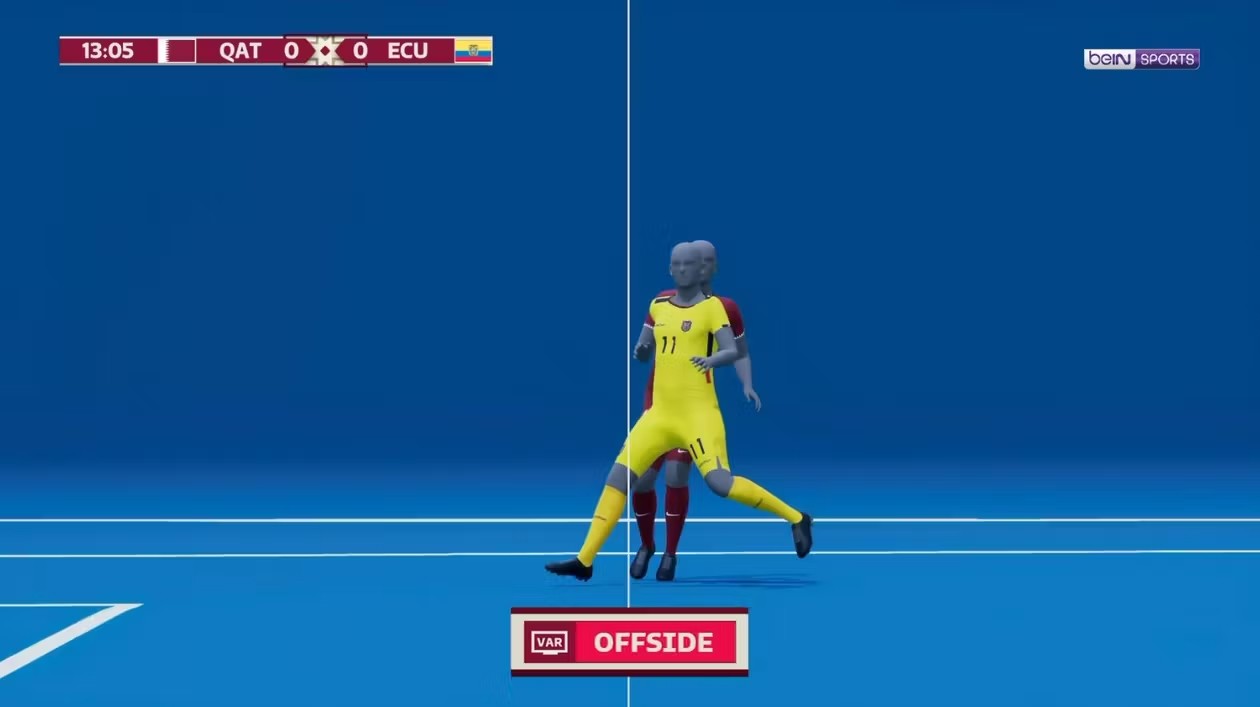
Semi-Automatic Offsides Detection Image© BEIN SPORTS / FIFA
TECHNOLOGY
By Peter Alegi and Laurent Dubois
In the past two decades the use of technology has transformed football and how fans experience it. Changes in the game itself, particularly around the use of Video Assistant Referee (VAR), have raised ongoing questions about the nature of rules and their enforcement. As is often the case, technology has been deployed with the idea that it will resolve controversy by offering clarity by supplementing or replacing human judgment. But the human elements of football, which are ultimately what make it operate as a sport and spectacle, have a way of overtaking these promises for technology. And, as is also the case in most other realms, technology has a way of creating as many new problems as it solves old ones.
Digital technology has also profoundly reshaped the experience of watching soccer, from how live matches are experienced in the stadium and on screens to how moments from games are curated and shared, especially on social media platforms. While much of this sharing simply takes the form of enthusiastic circulation of clips of goals, exciting moves, and memes, social media are also an arena for homophobic, racist and sexist commentary, and an important space of political intervention and debate.
Information technology has also increasingly shaped the use of sports science in training and player evaluation. The rise of football analytics has transformed the process of talent identification and team management, on and off the pitch. While sports like baseball, NFL football, and cricket are fundamentally reliant on statistics and big data for strategy, performance, and consumption, the adoption of increasingly sophisticated technologies in world football is creating new forms of measurement, decision making, and engagement.
In the past two decades the use of technology has transformed football and how fans experience it. Changes in the game itself, particularly around the use of Video Assistant Referee (VAR), have raised ongoing questions about the nature of rules and their enforcement. As is often the case, technology has been deployed with the idea that it will resolve controversy by offering clarity by supplementing or replacing human judgment. But the human elements of football, which are ultimately what make it operate as a sport and spectacle, have a way of overtaking these promises for technology. And, as is also the case in most other realms, technology has a way of creating as many new problems as it solves old ones.
Digital technology has also profoundly reshaped the experience of watching soccer, from how live matches are experienced in the stadium and on screens to how moments from games are curated and shared, especially on social media platforms. While much of this sharing simply takes the form of enthusiastic circulation of clips of goals, exciting moves, and memes, social media are also an arena for homophobic, racist and sexist commentary, and an important space of political intervention and debate.
Information technology has also increasingly shaped the use of sports science in training and player evaluation. The rise of football analytics has transformed the process of talent identification and team management, on and off the pitch. While sports like baseball, NFL football, and cricket are fundamentally reliant on statistics and big data for strategy, performance, and consumption, the adoption of increasingly sophisticated technologies in world football is creating new forms of measurement, decision making, and engagement.
In the past two decades the use of technology has transformed football and how fans experience it. Changes in the game itself, particularly around the use of Video Assistant Referee (VAR), have raised ongoing questions about the nature of rules and their enforcement. As is often the case, technology has been deployed with the idea that it will resolve controversy by offering clarity by supplementing or replacing human judgment. But the human elements of football, which are ultimately what make it operate as a sport and spectacle, have a way of overtaking these promises for technology. And, as is also the case in most other realms, technology has a way of creating as many new problems as it solves old ones.
Digital technology has also profoundly reshaped the experience of watching soccer, from how live matches are experienced in the stadium and on screens to how moments from games are curated and shared, especially on social media platforms. While much of this sharing simply takes the form of enthusiastic circulation of clips of goals, exciting moves, and memes, social media are also an arena for homophobic, racist and sexist commentary, and an important space of political intervention and debate.
Information technology has also increasingly shaped the use of sports science in training and player evaluation. The rise of football analytics has transformed the process of talent identification and team management, on and off the pitch. While sports like baseball, NFL football, and cricket are fundamentally reliant on statistics and big data for strategy, performance, and consumption, the adoption of increasingly sophisticated technologies in world football is creating new forms of measurement, decision making, and engagement.
Discussion questions:
What are the advantages and disadvantages of using VAR during matches?
Which ethical and legal questions are raised by the omnipresence of tech devices that record footballers’ personal health, nutritional, and fitness data?
To what extent do factors like race, gender, culture, and age shape similarities and differences in how football practitioners are represented (or self-represent) on social media?
How does technology on the field of play and in the boardroom help us answer a long-standing question: is football more art or science?
READINGS
FREE TO ACCESS SOURCES
Malan, David. 2023. “Lab 6: World Cup - CS50x 2023.” Course Project. Python Simulation of World Cup.
Malan, David. 2023. “Lab 6: World Cup - CS50x 2023.” Course Project. Python Simulation of World Cup.
Zhang, Yeqin, Danyang Li, Miguel-Ángel Gómez-Ruano, Daniel Memmert, Chunman Li, and Ming Fu. 2022. “The Effect of the Video Assistant Referee (VAR) on Referees’ Decisions at FIFA Women’s World Cups.” Frontiers in Psychology 13.
Zhang, Yeqin, Danyang Li, Miguel-Ángel Gómez-Ruano, Daniel Memmert, Chunman Li, and Ming Fu. 2022. “The Effect of the Video Assistant Referee (VAR) on Referees’ Decisions at FIFA Women’s World Cups.” Frontiers in Psychology 13.
Malan, David. 2023. “Lab 6: World Cup - CS50x 2023.” Course Project. Python Simulation of World Cup.
Malan, David. 2023. “Lab 6: World Cup - CS50x 2023.” Course Project. Python Simulation of World Cup.
Malan, David. 2023. “Lab 6: World Cup - CS50x 2023.” Course Project. Python Simulation of World Cup.
Malan, David. 2023. “Lab 6: World Cup - CS50x 2023.” Course Project. Python Simulation of World Cup.
FIFA. 2023. “Tactical & Technical Trends | FIFA Women’s World Cup 2023 | TSG Analysis.” August 9. Tactical & Technical trends | FIFA Women's World Cup 2023 | TSG Analysis
FIFA. 2023. “Tactical & Technical Trends | FIFA Women’s World Cup 2023 | TSG Analysis.” August 9. Tactical & Technical trends | FIFA Women's World Cup 2023 | TSG Analysis
Ala’ Alrababa’h, William Marble, Salma Mousa and Alexandra A. Siegel, “Can Exposure to Celebrities Reduce Prejudice? The Effect of Mohamed Salah on Islamophobic Behaviors and Attitudes.” American Political Science Review 115, no. 4 (2021): 1111–1128.
Ala’ Alrababa’h, William Marble, Salma Mousa and Alexandra A. Siegel, “Can Exposure to Celebrities Reduce Prejudice? The Effect of Mohamed Salah on Islamophobic Behaviors and Attitudes.” American Political Science Review 115, no. 4 (2021): 1111–1128.
ADDITIONAL SOURCES
Gary Foster, “VAR and Flow in Soccer (Football): Changes to the Fan Experience,” Sport, Ethics and Philosophy (November 2024), 1–16 .
Gary Foster, “VAR and Flow in Soccer (Football): Changes to the Fan Experience,” Sport, Ethics and Philosophy (November 2024), 1–16 .
Christophe Biermann, Football Hackers: The Science and Art of a Data Revolution (Blink, 2016);
Christophe Biermann, Football Hackers: The Science and Art of a Data Revolution (Blink, 2016);
Michael Cox, “Has the impact of analytics on modern football been overstated?”The Athletic, 09/11/2024
Michael Cox, “Has the impact of analytics on modern football been overstated?”The Athletic, 09/11/2024
READ NEXT





World Cup: The Syllabus is a project of the Global Sport Lab and the Jackson School of International Studies at the University of Washington.

CONTACT US
The Henry M. Jackson School of International Studies
2023 Skagit Lane, Thomson Hall, Box 353650 Seattle, WA 98195-3650
T: (206) 543-4370


Text on this page created by the Global Sport Lab at the
University of Washington is licensed under a CC BY-NC 4.0 license.
Images and video are not included.
CONTACT US
The Henry M. Jackson School of International Studies
2023 Skagit Lane, Thomson Hall, Box 353650 Seattle, WA 98195-3650
T: (206) 543-4370
Text on this page created by the Global Sport Lab at the
University of Washington is licensed under a CC BY-NC 4.0 license.
Images and video are not included.

CONTACT US
Text on this page created by the Global Sport Lab at the
University of Washington is licensed under a CC BY-NC 4.0 license.
Images and video are not included.
CONTACT US
Text on this page created by the Global Sport Lab at the
University of Washington is licensed under a CC BY-NC 4.0 license.
Images and video are not included.