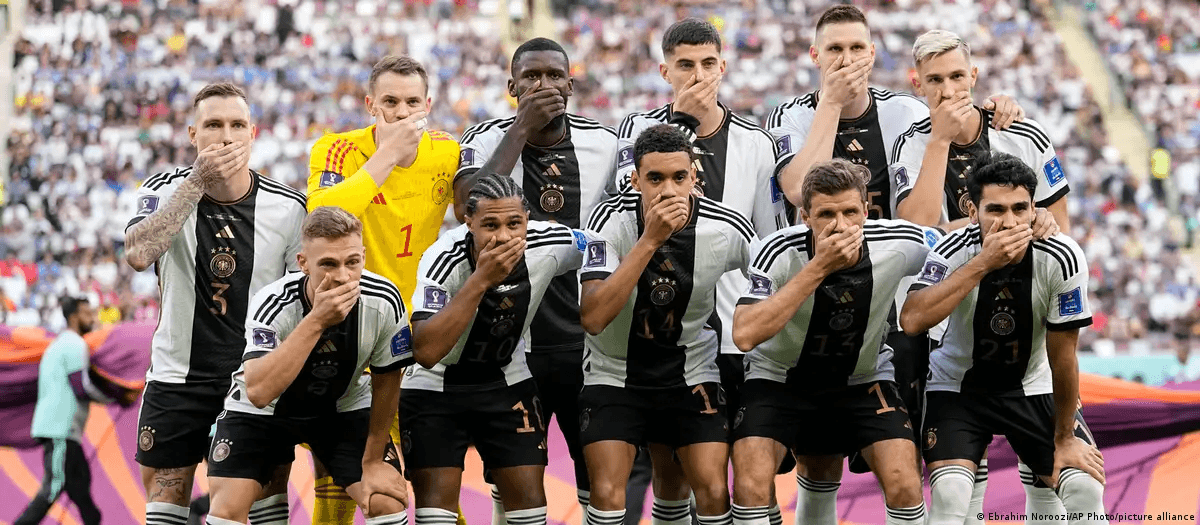
The German national team protests FIFA's decision to threaten discplinary action over the One Love armband.
Image© Ebrahim Noroozi/AP Photo/picture alliance
HUMAN RIGHTS
HUMAN
RIGHTS
By Martha Saavedra and Brenda Elsey
Just ahead of the 1999 Women’s World Cup hosted by the USA, the Secretary General of the United Nations, Kofi Annan, and FIFA president, Sepp Blatter, formed a partnership to foster human rights through global football. The legendary Brazilian player, Pelé looked on approvingly. This agreement supposedly opened a new chapter in FIFA’s commitment to human rights. It reflected a long history of activism through football, including the anti-apartheid movement in South Africa and the opposition to the military dictatorships in Latin America. By 2016, FIFA formalized their approach to human rights and adopted a policy, which has evolved since. Bidding nations for tournaments, for instance, are required to present human rights plans and FIFA has created a team to oversee compliance. However, human rights activists and organizations, including Amnesty International and Human Rights Watch, have found these plans and gestures have not successfully protected labor, environmental, housing or other human rights.
The FIFA Men’s World Cup of 2022 in Qatar sparked global controversies focused on the abuses of women’s and labor rights. Media narratives around Qatar were frequently laced with a Western sense of superiority and Islamophobia. The broader concept of universal human rights has been critiqued as a neo-liberal and colonialist political project. Furthermore, some see the promotion of human rights within sport as the epitome of sports-washing. The lead up to the 2026 World Cup has seen the inaugural and controversial FIFA Peace Prize awarded to the US President Donald Trump just as the US visitor visa regime has tightened, likely preventing travel to the US by fans of many of the participating nations. A few months later, Donald Trump commenced military attacks against Iran, whose men’s side is one of the 48 finalists for the 2026 World Cup and whose women’s side was competing in the AFC Women’s Asian Cup for a place in the 2027 Women’s World Cup in Brazil.
Many continue to believe that football, the world’s most beloved and global cultural practice, offers a unique space to promote the dignity of all people. Access to sport is part of that compact, intrinsically linked to education, health care, and freedom of expression. Indeed, recent editions of the Women’s World Cup have been very inclusive and welcoming spaces, especially for LGBTQIA+ players, officials, fans and journalists.
This section of World Cup: The Syllabus includes an overview of human rights and FIFA, official documents, and a few case studies. Readers will gain an overview of the institutional, policy, legal and discursive frameworks and the various ways the staging of World Cup tournaments can impact human rights.
Just ahead of the 1999 Women’s World Cup hosted by the USA, the Secretary General of the United Nations, Kofi Annan, and FIFA president, Sepp Blatter, formed a partnership to foster human rights through global football. The legendary Brazilian player, Pelé looked on approvingly. This agreement supposedly opened a new chapter in FIFA’s commitment to human rights. It reflected a long history of activism through football, including the anti-apartheid movement in South Africa and the opposition to the military dictatorships in Latin America. By 2016, FIFA formalized their approach to human rights and adopted a policy, which has evolved since. Bidding nations for tournaments, for instance, are required to present human rights plans and FIFA has created a team to oversee compliance. However, human rights activists and organizations, including Amnesty International and Human Rights Watch, have found these plans and gestures have not successfully protected labor, environmental, housing or other human rights.
The FIFA Men’s World Cup of 2022 in Qatar sparked global controversies focused on the abuses of women’s and labor rights. Media narratives around Qatar were frequently laced with a Western sense of superiority and Islamophobia. The broader concept of universal human rights has been critiqued as a neo-liberal and colonialist political project. Furthermore, some see the promotion of human rights within sport as the epitome of sports-washing. The lead up to the 2026 World Cup has seen the inaugural and controversial FIFA Peace Prize awarded to the US President Donald Trump just as the US visitor visa regime has tightened, likely preventing travel to the US by fans of many of the participating nations. A few months later, Donald Trump commenced military attacks against Iran, whose men’s side is one of the 48 finalists for the 2026 World Cup and whose women’s side was competing in the AFC Women’s Asian Cup for a place in the 2027 Women’s World Cup in Brazil.
Many continue to believe that football, the world’s most beloved and global cultural practice, offers a unique space to promote the dignity of all people. Access to sport is part of that compact, intrinsically linked to education, health care, and freedom of expression. Indeed, recent editions of the Women’s World Cup have been very inclusive and welcoming spaces, especially for LGBTQIA+ players, officials, fans and journalists.
This section of World Cup: The Syllabus includes an overview of human rights and FIFA, official documents, and a few case studies. Readers will gain an overview of the institutional, policy, legal and discursive frameworks and the various ways the staging of World Cup tournaments can impact human rights.
Just ahead of the 1999 Women’s World Cup hosted by the USA, the Secretary General of the United Nations, Kofi Annan, and FIFA president, Sepp Blatter, formed a partnership to foster human rights through global football. The legendary Brazilian player, Pelé looked on approvingly. This agreement supposedly opened a new chapter in FIFA’s commitment to human rights. It reflected a long history of activism through football, including the anti-apartheid movement in South Africa and the opposition to the military dictatorships in Latin America. By 2016, FIFA formalized their approach to human rights and adopted a policy, which has evolved since. Bidding nations for tournaments, for instance, are required to present human rights plans and FIFA has created a team to oversee compliance. However, human rights activists and organizations, including Amnesty International and Human Rights Watch, have found these plans and gestures have not successfully protected labor, environmental, housing or other human rights.
The FIFA Men’s World Cup of 2022 in Qatar sparked global controversies focused on the abuses of women’s and labor rights. Media narratives around Qatar were frequently laced with a Western sense of superiority and Islamophobia. The broader concept of universal human rights has been critiqued as a neo-liberal and colonialist political project. Furthermore, some see the promotion of human rights within sport as the epitome of sports-washing. The lead up to the 2026 World Cup has seen the inaugural and controversial FIFA Peace Prize awarded to the US President Donald Trump just as the US visitor visa regime has tightened, likely preventing travel to the US by fans of many of the participating nations. A few months later, Donald Trump commenced military attacks against Iran, whose men’s side is one of the 48 finalists for the 2026 World Cup and whose women’s side was competing in the AFC Women’s Asian Cup for a place in the 2027 Women’s World Cup in Brazil.
Many continue to believe that football, the world’s most beloved and global cultural practice, offers a unique space to promote the dignity of all people. Access to sport is part of that compact, intrinsically linked to education, health care, and freedom of expression. Indeed, recent editions of the Women’s World Cup have been very inclusive and welcoming spaces, especially for LGBTQIA+ players, officials, fans and journalists.
This section of World Cup: The Syllabus includes an overview of human rights and FIFA, official documents, and a few case studies. Readers will gain an overview of the institutional, policy, legal and discursive frameworks and the various ways the staging of World Cup tournaments can impact human rights.
Discussion questions:
Does performative human rights solidarity still hold the possibility for change?
How does one evaluate if and how human rights have been positively advanced in the context of the World Cup?
Is sports-washing inevitable in the context of FIFA World Cup tournaments? For example, is the Women’s World Cup an attempt to gender-wash unequal prize money and embezzled development funds?
What contradictions does sport highlight in the idea of universal human rights? Can it be a vehicle for promoting a broader understanding of “human” while respecting difference? (Consider the hijab ban, for example.)
Can the 2026 and 2027 World Cup tournaments claim to be truly accessible? What would FIFA need to implement to make the tournaments truly inclusive, particularly of fans with various disabilities?
READINGS
FREE TO ACCESS SOURCES
Duval and Heerdt. 2020. “FIFA and Human Rights – a Research Agenda.” Tilburg Law Review 25 (1)
Duval and Heerdt. 2020. “FIFA and Human Rights – a Research Agenda.” Tilburg Law Review 25 (1)
Hughes, Aaron W. "The Touchline of Fair Play: Football, Head Coverings and the Constantly Shifting Secular." In The Beautiful Game on a Muslim Pitch: How Football and Religion are Shaping Identity and Society, edited by Aaron W. Hughes and Leif Stenberg, 74–90. Edinburgh: Edinburgh University Press, 2025.
Hughes, Aaron W. "The Touchline of Fair Play: Football, Head Coverings and the Constantly Shifting Secular." In The Beautiful Game on a Muslim Pitch: How Football and Religion are Shaping Identity and Society, edited by Aaron W. Hughes and Leif Stenberg, 74–90. Edinburgh: Edinburgh University Press, 2025.
Rizwan, Nishfa, and Adam Ehsan Ali. 2025. “Muslimness, Women, and Sport: Interrogating Instagram Reactions to Morocco’s Benzina at the 2023 FIFA Women’s World Cup.” In Media, Communication and the 2023 FIFA Women’s World Cup. Routledge.
Rizwan, Nishfa, and Adam Ehsan Ali. 2025. “Muslimness, Women, and Sport: Interrogating Instagram Reactions to Morocco’s Benzina at the 2023 FIFA Women’s World Cup.” In Media, Communication and the 2023 FIFA Women’s World Cup. Routledge.
FIFA, Human Rights Strategy
FIFA, Human Rights Strategy
FIFA, Human Rights Policy
FIFA, Human Rights Policy
FIFA, Human Rights Documents
FIFA, Human Rights Documents
FIFA, Legal
FIFA, Legal
FIFA, World Cup 26 Human Rights Framework, June 2024 (sourced from the Centre for Sport and Human Rights)
FIFA, World Cup 26 Human Rights Framework, June 2024 (sourced from the Centre for Sport and Human Rights)
ADDITIONAL SOURCES
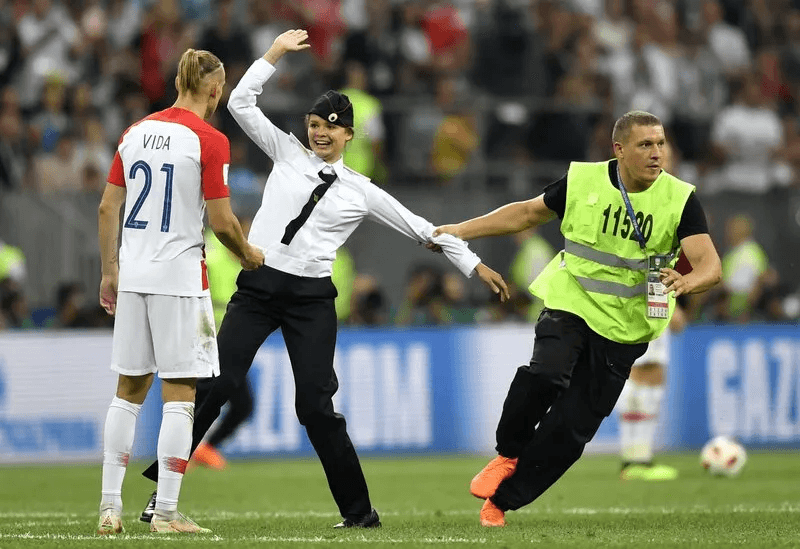
Iakimova, Olga. 2021. “The Case of Pussy Riot’s Protest at the World Cup 2018 in Russia:‘The Policeman Enters the Game.’” In Russia and the 2018 FIFA World Cup. Routledge.
Iakimova, Olga. 2021. “The Case of Pussy Riot’s Protest at the World Cup 2018 in Russia:‘The Policeman Enters the Game.’” In Russia and the 2018 FIFA World Cup. Routledge.
Griffin, T. R. “Stories Retold: Qatar 2022, Saudi Arabia 2034, and How Gulf Football Is Framed Within a Global Football Discourse,” Social Research: An International Quarterly 92, no. 3 (2025): 785-809
Griffin, T. R. “Stories Retold: Qatar 2022, Saudi Arabia 2034, and How Gulf Football Is Framed Within a Global Football Discourse,” Social Research: An International Quarterly 92, no. 3 (2025): 785-809
READ NEXT
World Cup: The Syllabus is a project of the Global Sport Lab and the Jackson School of International Studies at the University of Washington.

CONTACT US
The Henry M. Jackson School of International Studies
2023 Skagit Lane, Thomson Hall, Box 353650 Seattle, WA 98195-3650
T: (206) 543-4370


Text on this page created by the Global Sport Lab at the
University of Washington is licensed under a CC BY-NC 4.0 license.
Images and video are not included.
CONTACT US
The Henry M. Jackson School of International Studies
2023 Skagit Lane, Thomson Hall, Box 353650 Seattle, WA 98195-3650
T: (206) 543-4370
Text on this page created by the Global Sport Lab at the
University of Washington is licensed under a CC BY-NC 4.0 license.
Images and video are not included.

CONTACT US
Text on this page created by the Global Sport Lab at the
University of Washington is licensed under a CC BY-NC 4.0 license.
Images and video are not included.
CONTACT US
Text on this page created by the Global Sport Lab at the
University of Washington is licensed under a CC BY-NC 4.0 license.
Images and video are not included.