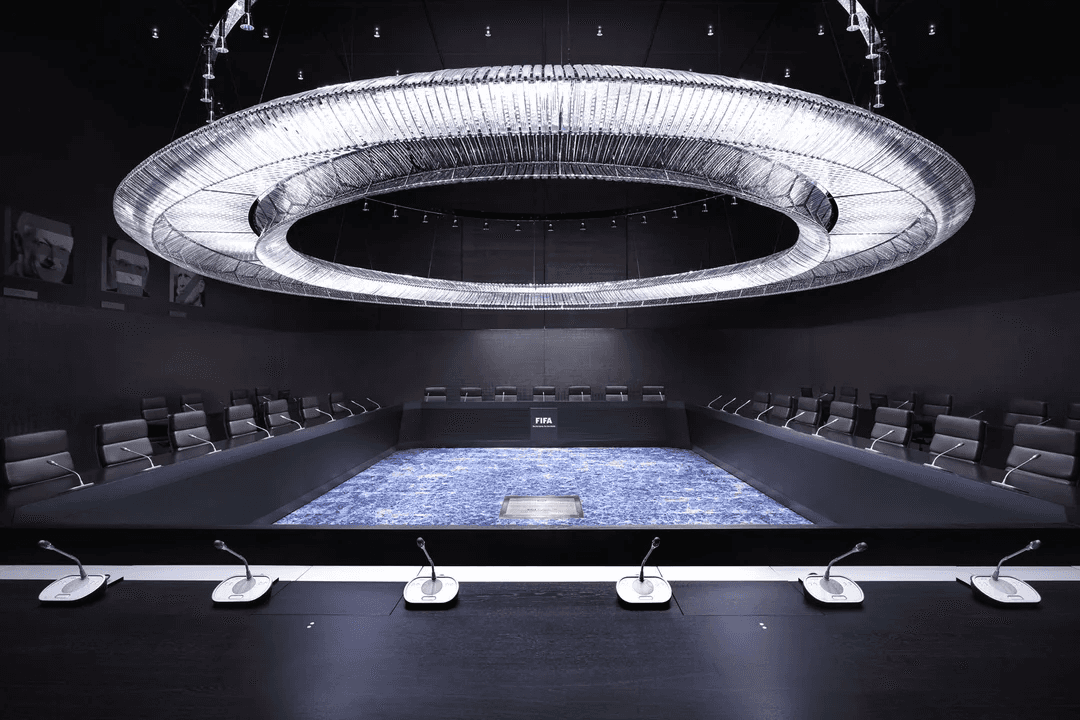
FIFA's Executive Boardroom Image© Reddit Archive
FIFA
FIFA
By Martha Saavedra and Peter Alegi
Founded in 1904, Fédération Internationale de Football Association (FIFA) is the game’s world governing body. It is an international non-governmental organization with a membership of 211 national associations, headquartered in Zurich, Switzerland. Its official aims are to organize international competitions, develop football and expand FIFA’s presence globally “to better serve our fans and all our stakeholders” according to the current president, Gianni Infantino. Assuring that the World Cup men’s and women’s tournaments occur regularly is central to FIFA’s raison d'être, with the men’s tournament generating more than 90 percent of FIFA’s overall revenue.
FIFA is much more than a sporting organization. It is also a network of power, finance, and influence on a global scale. By organizing the World Cup and other competitions at senior and junior level, it has paradoxically fostered the simultaneous growth of internationalism and nationalism. In the 1950 and 1960s, it welcomed newly independent nations from Africa and Asia that did much to genuinely globalize soccer. Over the next three decades, FIFA sanctions against apartheid South Africa demonstrated a commitment to inclusion and anti-racism. In the 1980s and 1990s, the world body transformed itself into a money-driven business operated in partnership with corporate sponsors and media companies. In the 21st century, FIFA’s rhetoric of peace and unity through football has been undermined as a result of poor governance and major corruption scandals.
FIFA today mobilizes vast sums of money, labor, physical infrastructure and media attention—accumulating considerable wealth for itself by extracting vast sums from fans, World Cup host countries and cities, sponsors and media. Due to the power and influence that FIFA has over the global game, we have included sources published by FIFA. However, we encourage you to engage with these sources critically and to keep in mind who benefits most from the policies and positions that FIFA adopts.
Founded in 1904, Fédération Internationale de Football Association (FIFA) is the game’s world governing body. It is an international non-governmental organization with a membership of 211 national associations, headquartered in Zurich, Switzerland. Its official aims are to organize international competitions, develop football and expand FIFA’s presence globally “to better serve our fans and all our stakeholders” according to the current president, Gianni Infantino. Assuring that the World Cup men’s and women’s tournaments occur regularly is central to FIFA’s raison d'être, with the men’s tournament generating more than 90 percent of FIFA’s overall revenue.
FIFA is much more than a sporting organization. It is also a network of power, finance, and influence on a global scale. By organizing the World Cup and other competitions at senior and junior level, it has paradoxically fostered the simultaneous growth of internationalism and nationalism. In the 1950 and 1960s, it welcomed newly independent nations from Africa and Asia that did much to genuinely globalize soccer. Over the next three decades, FIFA sanctions against apartheid South Africa demonstrated a commitment to inclusion and anti-racism. In the 1980s and 1990s, the world body transformed itself into a money-driven business operated in partnership with corporate sponsors and media companies. In the 21st century, FIFA’s rhetoric of peace and unity through football has been undermined as a result of poor governance and major corruption scandals.
FIFA today mobilizes vast sums of money, labor, physical infrastructure and media attention—accumulating considerable wealth for itself by extracting vast sums from fans, World Cup host countries and cities, sponsors and media. Due to the power and influence that FIFA has over the global game, we have included sources published by FIFA. However, we encourage you to engage with these sources critically and to keep in mind who benefits most from the policies and positions that FIFA adopts.
Founded in 1904, Fédération Internationale de Football Association (FIFA) is the game’s world governing body. It is an international non-governmental organization with a membership of 211 national associations, headquartered in Zurich, Switzerland. Its official aims are to organize international competitions, develop football and expand FIFA’s presence globally “to better serve our fans and all our stakeholders” according to the current president, Gianni Infantino. Assuring that the World Cup men’s and women’s tournaments occur regularly is central to FIFA’s raison d'être, with the men’s tournament generating more than 90 percent of FIFA’s overall revenue.
FIFA is much more than a sporting organization. It is also a network of power, finance, and influence on a global scale. By organizing the World Cup and other competitions at senior and junior level, it has paradoxically fostered the simultaneous growth of internationalism and nationalism. In the 1950 and 1960s, it welcomed newly independent nations from Africa and Asia that did much to genuinely globalize soccer. Over the next three decades, FIFA sanctions against apartheid South Africa demonstrated a commitment to inclusion and anti-racism. In the 1980s and 1990s, the world body transformed itself into a money-driven business operated in partnership with corporate sponsors and media companies. In the 21st century, FIFA’s rhetoric of peace and unity through football has been undermined as a result of poor governance and major corruption scandals.
FIFA today mobilizes vast sums of money, labor, physical infrastructure and media attention—accumulating considerable wealth for itself by extracting vast sums from fans, World Cup host countries and cities, sponsors and media. Due to the power and influence that FIFA has over the global game, we have included sources published by FIFA. However, we encourage you to engage with these sources critically and to keep in mind who benefits most from the policies and positions that FIFA adopts.
Discussion questions:
It is often stated that FIFA is the most powerful and influential sporting organization in the world. How does its structure, purpose, and conduct compare to the International Olympic Committee, World Athletics, the International Cricket Council and other sporting bodies?
The Men’s World Cup is FIFA’s main revenue source, but how important is FIFA to World Cup host nations, corporate sponsors, media and fans? Who are the “winners” and “losers” in this global spectacle?
Which political, economic, and cultural factors influence countries’ decision to host World Cup tournaments?
How and where does football exist outside of FIFA?
Is an organization like FIFA necessary for football? Should FIFA be reformed? Can it be reformed? If so, how?
In what ways is FIFA a help or hindrance in advancing the women’s game?
READINGS
FREE TO ACCESS SOURCES
FairSquare. Substitute: FIFA not fit to govern world football, external reform essential to prevent future harm. October 30, 2024
FairSquare. Substitute: FIFA not fit to govern world football, external reform essential to prevent future harm. October 30, 2024
National Football Museum, “The fascinating history of the Women’s World Cup”
National Football Museum, “The fascinating history of the Women’s World Cup”
Lima Sampaio, Maria Eduarda, and Júlia Barreira. 2026. “Thirty-Two Years of Inequality in Coaching at the FIFA Women’s World Cup (1991–2023): Do Gender, Race and Region Matter?” Soccer & Society 27 (2–3): 389–408. doi:10.1080/14660970.2025.2603769.
Lima Sampaio, Maria Eduarda, and Júlia Barreira. 2026. “Thirty-Two Years of Inequality in Coaching at the FIFA Women’s World Cup (1991–2023): Do Gender, Race and Region Matter?” Soccer & Society 27 (2–3): 389–408. doi:10.1080/14660970.2025.2603769.
Desjardins, Bridgette M. "Mobilising Gender Equality: A Discourse Analysis of Bids to Host the FIFA Women's World Cup 2023™." International Review for the Sociology of Sport 56, no. 8 (2021): 1189–1205.
Desjardins, Bridgette M. "Mobilising Gender Equality: A Discourse Analysis of Bids to Host the FIFA Women's World Cup 2023™." International Review for the Sociology of Sport 56, no. 8 (2021): 1189–1205.
Football Scholars Forum, Beyond Boosterism: Roundtable on the 2023 Women’s World Cup, 2023
Football Scholars Forum, Beyond Boosterism: Roundtable on the 2023 Women’s World Cup, 2023
CIES (International Centre for Sport Studies), CIES Football Observatory
CIES (International Centre for Sport Studies), CIES Football Observatory
FIFA, What FIFA Does
FIFA, What FIFA Does
FIFA, Organizational Components
FIFA, Organizational Components
FIFA, Strategic Objectives: 2023-2027
FIFA, Strategic Objectives: 2023-2027
FIFA, Campaigns
FIFA, Campaigns
FIFA, Member Associations
FIFA, Member Associations
FIFA, Official Documents
FIFA, Official Documents
FIFA Archives
FIFA Archives
FIFA Men’s World Cup Archives
FIFA Men’s World Cup Archives
FIFA, Women’s World Cup Archives
FIFA, Women’s World Cup Archives
FIFA, Tournament Films
FIFA, Tournament Films
ADDITIONAL SOURCES
Alan Tomlinson, FIFA: The Men, the Myths and the Money (Routledge, 2014);
Alan Tomlinson, FIFA: The Men, the Myths and the Money (Routledge, 2014);
Jean Williams, A Beautiful Game: International Perspectives on Women’s Football (Berg, 2007);
Jean Williams, A Beautiful Game: International Perspectives on Women’s Football (Berg, 2007);
Brenda Elsey and Joshua Nadel, Futbolera: A History of Women and Sports in Latin America (University of Texas Press, 2018);
Brenda Elsey and Joshua Nadel, Futbolera: A History of Women and Sports in Latin America (University of Texas Press, 2018);
Peter Alegi, “‘Feel the Pull in Your Soul’: Local Agency and Global Trends in South Africa's 2006 World Cup Bid,” Soccer & Society 2, no. 3 (2001): 1–21.
Peter Alegi, “‘Feel the Pull in Your Soul’: Local Agency and Global Trends in South Africa's 2006 World Cup Bid,” Soccer & Society 2, no. 3 (2001): 1–21.
READ NEXT
World Cup: The Syllabus is a project of the Global Sport Lab and the Jackson School of International Studies at the University of Washington.

CONTACT US
The Henry M. Jackson School of International Studies
2023 Skagit Lane, Thomson Hall, Box 353650 Seattle, WA 98195-3650
T: (206) 543-4370


Text on this page created by the Global Sport Lab at the
University of Washington is licensed under a CC BY-NC 4.0 license.
Images and video are not included.
CONTACT US
The Henry M. Jackson School of International Studies
2023 Skagit Lane, Thomson Hall, Box 353650 Seattle, WA 98195-3650
T: (206) 543-4370
Text on this page created by the Global Sport Lab at the
University of Washington is licensed under a CC BY-NC 4.0 license.
Images and video are not included.

CONTACT US
Text on this page created by the Global Sport Lab at the
University of Washington is licensed under a CC BY-NC 4.0 license.
Images and video are not included.
CONTACT US
Text on this page created by the Global Sport Lab at the
University of Washington is licensed under a CC BY-NC 4.0 license.
Images and video are not included.