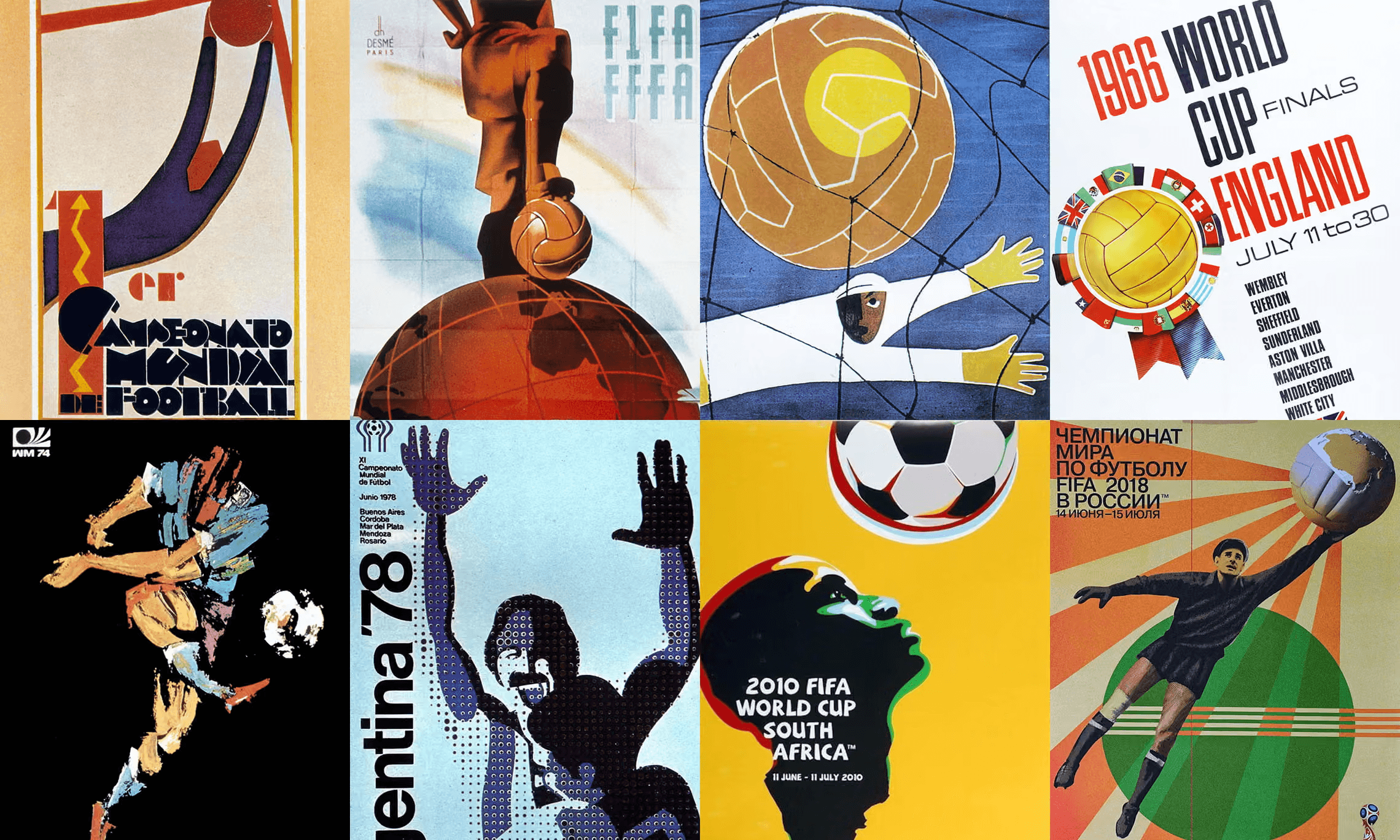
World Cup Poster Composite Image© FIFA
WORLD CUP: THE SYLLABUS
WORLD CUP:
THE SYLLABUS
WORLD CUP:
THE SYLLABUS
Introduction By Ron Krabill
Welcome to World Cup: The Syllabus! We’re glad that you’re here. World Cup: The Syllabus is intended for anyone interested in learning more about the history and politics of the World Cup, curious about some of the current and past controversies, or just wants to understand a little more about why people care so very much about these global events that take place every four years.
What you’ll find in the following links and pages are a series of curated readings to help us all think more deeply about the FIFA World Cup from a wide variety of perspectives. While it has become cliché to describe the men’s World Cup as the largest sporting event in the world, the predictability of that statement makes it no less true; the World Cup is a cultural phenomenon unlike any other. But like any cultural phenomenon, the World Cup can – indeed, we would argue it must – be looked at with a critical eye, paying attention to all the many ways that people understand the importance of the event for their own lives. This means examining it through the lens not only of global sport, but also of global economies, geopolitics, and transnational flows of culture and media. Our goal is to provide the historical, political, and cultural contexts to begin to think more critically about the football World Cup – both the men’s and the women’s tournaments. Here we mean critical not just in the sense of critiquing the tournaments themselves and the choices made by organizers, local and international, over many decades (and there is plenty to critique there), but also critique as a way of taking seriously how people make meaning through these festivals of competition and connection.
World Cup: The Syllabus has been curated by an Editorial Team comprised of some of the top scholars of global football; please do read more about each of our Editorial Team members and read more of their work on global football – it’s an impressive and compelling set of scholars! We have chosen intentionally to include both the women’s and the men’s World Cups in these pages because of our commitment to understand the role of gender within and across the dynamics of both tournaments and over time, along with gender’s intersectionality with race, class, sexuality, and many other identities. We also recognize that the volume of writing on men’s football vastly surpasses that on women’s football to date; this syllabus thus reflects that inequity while simultaneously attempting to begin to address it.
We hope that you find the writings here both insightful and informative, and that they ignite an interest in delving deeper – not only into each subtheme we’ve included here, but across the full breadth of writing on not only the World Cup but also global football and global sport more generally. World Cup: The Syllabus makes no claims to being all-encompassing, or even definitive. We have chosen a select number of subthemes to explore, but these represent only the smallest fraction of the subthemes that we could have included. Rather, we hope that the project serves to inspire an ongoing interest in viewing cultural phenomenon like the World Cup from a more thoughtful and politically engaged perspective, even and especially as we enjoy the beautiful game and all the joy that it brings so many people around the world.
Welcome to World Cup: The Syllabus! We’re glad that you’re here. World Cup: The Syllabus is intended for anyone interested in learning more about the history and politics of the World Cup, curious about some of the current and past controversies, or just wants to understand a little more about why people care so very much about these global events that take place every four years.
What you’ll find in the following links and pages are a series of curated readings to help us all think more deeply about the FIFA World Cup from a wide variety of perspectives. While it has become cliché to describe the men’s World Cup as the largest sporting event in the world, the predictability of that statement makes it no less true; the World Cup is a cultural phenomenon unlike any other. But like any cultural phenomenon, the World Cup can – indeed, we would argue it must – be looked at with a critical eye, paying attention to all the many ways that people understand the importance of the event for their own lives. This means examining it through the lens not only of global sport, but also of global economies, geopolitics, and transnational flows of culture and media. Our goal is to provide the historical, political, and cultural contexts to begin to think more critically about the football World Cup – both the men’s and the women’s tournaments. Here we mean critical not just in the sense of critiquing the tournaments themselves and the choices made by organizers, local and international, over many decades (and there is plenty to critique there), but also critique as a way of taking seriously how people make meaning through these festivals of competition and connection.
World Cup: The Syllabus has been curated by an Editorial Team comprised of some of the top scholars of global football; please do read more about each of our Editorial Team members and read more of their work on global football – it’s an impressive and compelling set of scholars! We have chosen intentionally to include both the women’s and the men’s World Cups in these pages because of our commitment to understand the role of gender within and across the dynamics of both tournaments and over time, along with gender’s intersectionality with race, class, sexuality, and many other identities. We also recognize that the volume of writing on men’s football vastly surpasses that on women’s football to date; this syllabus thus reflects that inequity while simultaneously attempting to begin to address it.
We hope that you find the writings here both insightful and informative, and that they ignite an interest in delving deeper – not only into each subtheme we’ve included here, but across the full breadth of writing on not only the World Cup but also global football and global sport more generally. World Cup: The Syllabus makes no claims to being all-encompassing, or even definitive. We have chosen a select number of subthemes to explore, but these represent only the smallest fraction of the subthemes that we could have included. Rather, we hope that the project serves to inspire an ongoing interest in viewing cultural phenomenon like the World Cup from a more thoughtful and politically engaged perspective, even and especially as we enjoy the beautiful game and all the joy that it brings so many people around the world.
Welcome to World Cup: The Syllabus! We’re glad that you’re here. World Cup: The Syllabus is intended for anyone interested in learning more about the history and politics of the World Cup, curious about some of the current and past controversies, or just wants to understand a little more about why people care so very much about these global events that take place every four years.
What you’ll find in the following links and pages are a series of curated readings to help us all think more deeply about the FIFA World Cup from a wide variety of perspectives. While it has become cliché to describe the men’s World Cup as the largest sporting event in the world, the predictability of that statement makes it no less true; the World Cup is a cultural phenomenon unlike any other. But like any cultural phenomenon, the World Cup can – indeed, we would argue it must – be looked at with a critical eye, paying attention to all the many ways that people understand the importance of the event for their own lives. This means examining it through the lens not only of global sport, but also of global economies, geopolitics, and transnational flows of culture and media. Our goal is to provide the historical, political, and cultural contexts to begin to think more critically about the football World Cup – both the men’s and the women’s tournaments. Here we mean critical not just in the sense of critiquing the tournaments themselves and the choices made by organizers, local and international, over many decades (and there is plenty to critique there), but also critique as a way of taking seriously how people make meaning through these festivals of competition and connection.
World Cup: The Syllabus has been curated by an Editorial Team comprised of some of the top scholars of global football; please do read more about each of our Editorial Team members and read more of their work on global football – it’s an impressive and compelling set of scholars! We have chosen intentionally to include both the women’s and the men’s World Cups in these pages because of our commitment to understand the role of gender within and across the dynamics of both tournaments and over time, along with gender’s intersectionality with race, class, sexuality, and many other identities. We also recognize that the volume of writing on men’s football vastly surpasses that on women’s football to date; this syllabus thus reflects that inequity while simultaneously attempting to begin to address it.
We hope that you find the writings here both insightful and informative, and that they ignite an interest in delving deeper – not only into each subtheme we’ve included here, but across the full breadth of writing on not only the World Cup but also global football and global sport more generally. World Cup: The Syllabus makes no claims to being all-encompassing, or even definitive. We have chosen a select number of subthemes to explore, but these represent only the smallest fraction of the subthemes that we could have included. Rather, we hope that the project serves to inspire an ongoing interest in viewing cultural phenomenon like the World Cup from a more thoughtful and politically engaged perspective, even and especially as we enjoy the beautiful game and all the joy that it brings so many people around the world.

World Cup: The Syllabus is a project of the Global Sport Lab and the
Jackson School of International Studies at the University of Washington.
World Cup: The Syllabus is a project of the Global Sport Lab and the Jackson School of International Studies at the University of Washington.

CONTACT US
The Henry M. Jackson School of International Studies
2023 Skagit Lane, Thomson Hall, Box 353650 Seattle, WA 98195-3650
T: (206) 543-4370


Text on this page created by the Global Sport Lab at the
University of Washington is licensed under a CC BY-NC 4.0 license.
Images and video are not included.
CONTACT US
The Henry M. Jackson School of International Studies
2023 Skagit Lane, Thomson Hall, Box 353650 Seattle, WA 98195-3650
T: (206) 543-4370
Text on this page created by the Global Sport Lab at the
University of Washington is licensed under a CC BY-NC 4.0 license.
Images and video are not included.

CONTACT US
Text on this page created by the Global Sport Lab at the
University of Washington is licensed under a CC BY-NC 4.0 license.
Images and video are not included.
CONTACT US
Text on this page created by the Global Sport Lab at the
University of Washington is licensed under a CC BY-NC 4.0 license.
Images and video are not included.