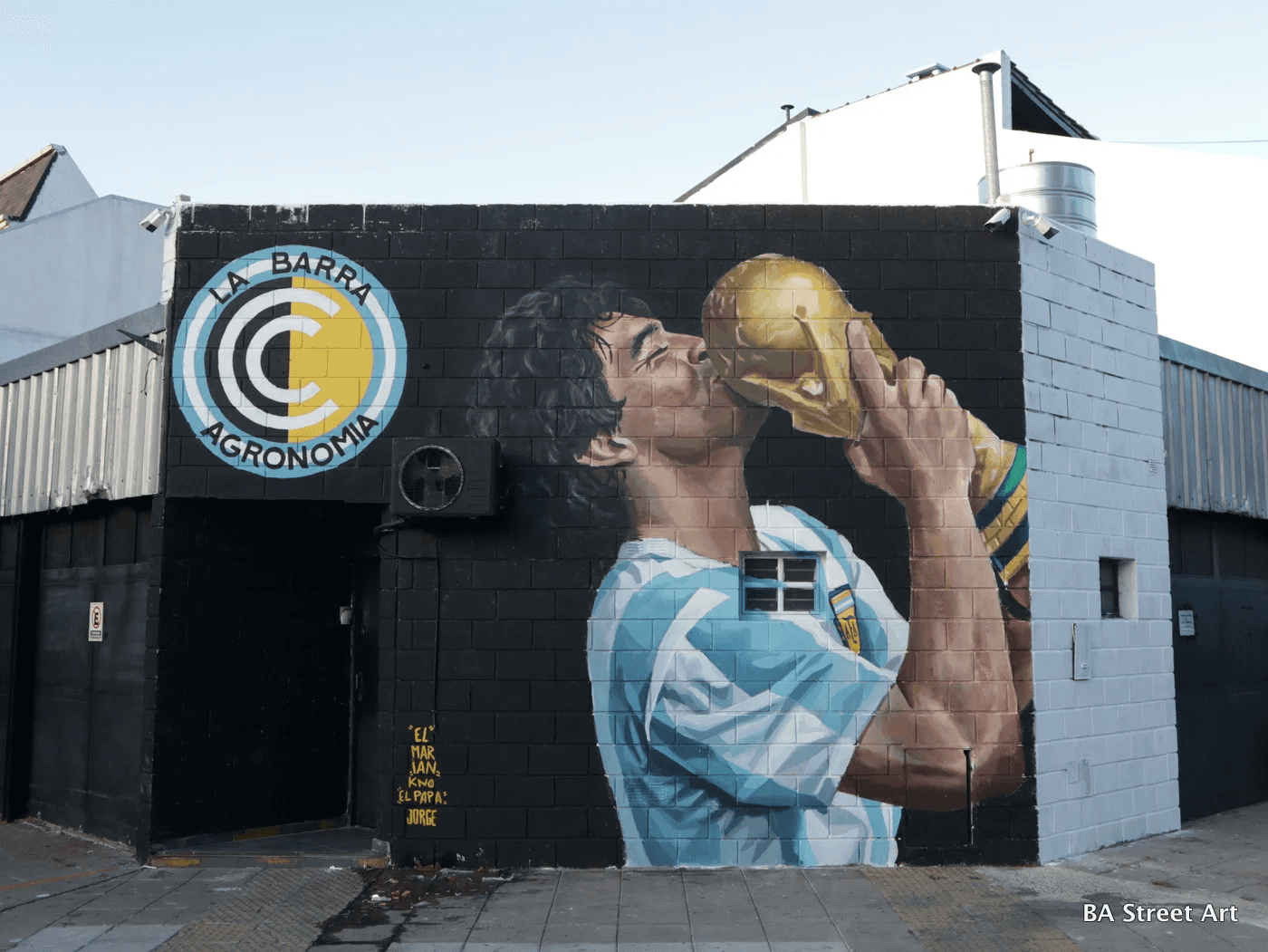
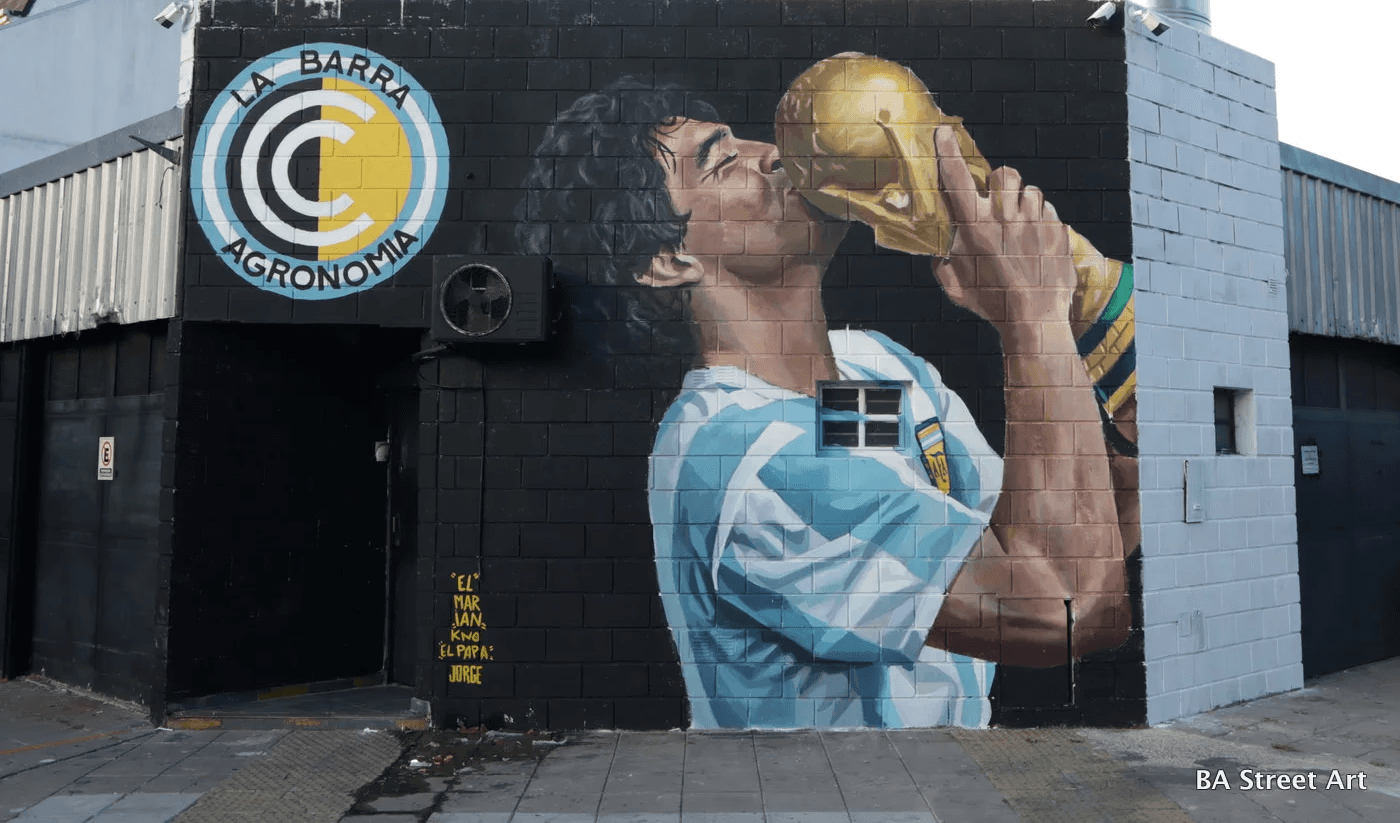
Mural of Diego Maradona by El Marian, KNO & Jorge Image© BA Street Art
ARTS AND CULTURE
ARTS AND
CULTURE
By Laurent Dubois and Sean Jacobs
Art and the World Cup have long been intertwined. This connection is evident in the tournament’s tradition of the hosts commissioning an official poster, starting with the first edition in 1930 in Uruguay. Over the years, these official posters have linked football to visual culture and reflected the national cultures of the host nations. They have also reflected shifts in art movements and technology, in the game itself, and reflected aspects of the national cultures of the host nations. Over time, poster art also mirrored the tournament’s growing commercialization and governing body FIFA’s attempts to control expression.
At the same time, collaboration between the art world and football has grown in recent decades. Since around 2010, major curated exhibitions have accompanied the tournament, such as the 2010 “Fine Art Collection” in Johannesburg, “Futbol: The Beautiful Game” at LACMA in Los Angeles in 2014, and “The World’s Game: Fútbol and Contemporary Art” at the Perez Art Museum in Miami in 2018.
At times, the game itself becomes artistic subject matter. This has notably been the case surrounding the famous incident where, in the closing moments of the 2006 FIFA World Cup Final, France’s captain Zinedine Zidane head-butted an Italian opponent after a provocation. The act shocked audiences around the world. It was also interpreted as a political moment, raising questions about race, language, and postcolonial identity. Artistic works produced about this event include the sculpture “Coup de tête” by Adel Abdessemed, as well as works by Harun Farocki and the poet Claudia Rankine.
The World Cup has also generated a great deal of music, from songs created to support particular teams to formal and informal anthems that have accompanied the tournaments.
While fans have expressed themselves through banners and tifos in stadiums, digital media has further expanded the relationship between art and the World Cup. Social platforms reduce costs and remove the need for physical venues. They allow artists to circulate work instantly and globally. They also create space for critical and oppositional art about the World Cup or as commentary on contemporary political struggles (authoritarianism, fascism, genocide). Digital media will certainly shape and showcase artistic responses to the upcoming tournament in the United States as well.
Art and the World Cup have long been intertwined. This connection is evident in the tournament’s tradition of the hosts commissioning an official poster, starting with the first edition in 1930 in Uruguay. Over the years, these official posters have linked football to visual culture and reflected the national cultures of the host nations. They have also reflected shifts in art movements and technology, in the game itself, and reflected aspects of the national cultures of the host nations. Over time, poster art also mirrored the tournament’s growing commercialization and governing body FIFA’s attempts to control expression.
At the same time, collaboration between the art world and football has grown in recent decades. Since around 2010, major curated exhibitions have accompanied the tournament, such as the 2010 “Fine Art Collection” in Johannesburg, “Futbol: The Beautiful Game” at LACMA in Los Angeles in 2014, and “The World’s Game: Fútbol and Contemporary Art” at the Perez Art Museum in Miami in 2018.
At times, the game itself becomes artistic subject matter. This has notably been the case surrounding the famous incident where, in the closing moments of the 2006 FIFA World Cup Final, France’s captain Zinedine Zidane head-butted an Italian opponent after a provocation. The act shocked audiences around the world. It was also interpreted as a political moment, raising questions about race, language, and postcolonial identity. Artistic works produced about this event include the sculpture “Coup de tête” by Adel Abdessemed, as well as works by Harun Farocki and the poet Claudia Rankine.
The World Cup has also generated a great deal of music, from songs created to support particular teams to formal and informal anthems that have accompanied the tournaments.
While fans have expressed themselves through banners and tifos in stadiums, digital media has further expanded the relationship between art and the World Cup. Social platforms reduce costs and remove the need for physical venues. They allow artists to circulate work instantly and globally. They also create space for critical and oppositional art about the World Cup or as commentary on contemporary political struggles (authoritarianism, fascism, genocide). Digital media will certainly shape and showcase artistic responses to the upcoming tournament in the United States as well.
Art and the World Cup have long been intertwined. This connection is evident in the tournament’s tradition of the hosts commissioning an official poster, starting with the first edition in 1930 in Uruguay. Over the years, these official posters have linked football to visual culture and reflected the national cultures of the host nations. They have also reflected shifts in art movements and technology, in the game itself, and reflected aspects of the national cultures of the host nations. Over time, poster art also mirrored the tournament’s growing commercialization and governing body FIFA’s attempts to control expression.
At the same time, collaboration between the art world and football has grown in recent decades. Since around 2010, major curated exhibitions have accompanied the tournament, such as the 2010 “Fine Art Collection” in Johannesburg, “Futbol: The Beautiful Game” at LACMA in Los Angeles in 2014, and “The World’s Game: Fútbol and Contemporary Art” at the Perez Art Museum in Miami in 2018.
At times, the game itself becomes artistic subject matter. This has notably been the case surrounding the famous incident where, in the closing moments of the 2006 FIFA World Cup Final, France’s captain Zinedine Zidane head-butted an Italian opponent after a provocation. The act shocked audiences around the world. It was also interpreted as a political moment, raising questions about race, language, and postcolonial identity. Artistic works produced about this event include the sculpture “Coup de tête” by Adel Abdessemed, as well as works by Harun Farocki and the poet Claudia Rankine.
The World Cup has also generated a great deal of music, from songs created to support particular teams to formal and informal anthems that have accompanied the tournaments.
While fans have expressed themselves through banners and tifos in stadiums, digital media has further expanded the relationship between art and the World Cup. Social platforms reduce costs and remove the need for physical venues. They allow artists to circulate work instantly and globally. They also create space for critical and oppositional art about the World Cup or as commentary on contemporary political struggles (authoritarianism, fascism, genocide). Digital media will certainly shape and showcase artistic responses to the upcoming tournament in the United States as well.
Discussion questions:
How does the form of football invite interpretation through artistic expression?
Can you find examples of artistic representations, in various media, surrounding the World Cup?
In what ways has artistic expression created spaces for political commentary and critique surrounding the World Cup?
Might football itself be considered a form of art?
READINGS
FREE TO ACCESS SOURCES
Jennifer Doyle, “Soccer, Art, and Desire,” 2011
Jennifer Doyle, “Soccer, Art, and Desire,” 2011
Marra, Pedro Silva, and Felipe Trotta. "Sound, Music and Magic in Football Stadiums." Popular Music 38, no. 1 (2019): 73–89.
Marra, Pedro Silva, and Felipe Trotta. "Sound, Music and Magic in Football Stadiums." Popular Music 38, no. 1 (2019): 73–89.
Ghobain, Elham Abdullah, Rania Mjahad, and Suha Alansari. "Exploring National Identity in World Sports: A Thematic Analysis of Media Portrayals of Morocco's National Team in the 2022 FIFA World Cup." SAGE Open 15, no. 2 (2025): 1–15.
Ghobain, Elham Abdullah, Rania Mjahad, and Suha Alansari. "Exploring National Identity in World Sports: A Thematic Analysis of Media Portrayals of Morocco's National Team in the 2022 FIFA World Cup." SAGE Open 15, no. 2 (2025): 1–15.
Daniel Haxell,” From Galáctico to Head Butt: Globalization, Immigration and the Politics of Identity in Artistic Reproductions of Zidane,” Football and the Boundaries of History
Daniel Haxell,” From Galáctico to Head Butt: Globalization, Immigration and the Politics of Identity in Artistic Reproductions of Zidane,” Football and the Boundaries of History
Duane Jethro, “Vuvuzela Magic: The Production and Consumption of ‘African’ Cultural Heritage during the FIFA 2010 World Cup,” African Diaspora, 7 (2014): 177–204.
Duane Jethro, “Vuvuzela Magic: The Production and Consumption of ‘African’ Cultural Heritage during the FIFA 2010 World Cup,” African Diaspora, 7 (2014): 177–204.
ADDITIONAL SOURCES
Steven C. Dubin, “Imperfect Pitch: Pop Culture, Consensus, and Resistance during the 2010 World Cup,” African Arts 44, no. 2 (2011): 18–31;
Steven C. Dubin, “Imperfect Pitch: Pop Culture, Consensus, and Resistance during the 2010 World Cup,” African Arts 44, no. 2 (2011): 18–31;
Daniel Haxall,” From Galáctico to Head Butt: Globalization, Immigration and the Politics of Identity in Artistic Reproductions of Zidane,” Football and the Boundaries of History
Daniel Haxall,” From Galáctico to Head Butt: Globalization, Immigration and the Politics of Identity in Artistic Reproductions of Zidane,” Football and the Boundaries of History
READ NEXT
World Cup: The Syllabus is a project of the Global Sport Lab and the Jackson School of International Studies at the University of Washington.

CONTACT US
The Henry M. Jackson School of International Studies
2023 Skagit Lane, Thomson Hall, Box 353650 Seattle, WA 98195-3650
T: (206) 543-4370


Text on this page created by the Global Sport Lab at the
University of Washington is licensed under a CC BY-NC 4.0 license.
Images and video are not included.
CONTACT US
The Henry M. Jackson School of International Studies
2023 Skagit Lane, Thomson Hall, Box 353650 Seattle, WA 98195-3650
T: (206) 543-4370
Text on this page created by the Global Sport Lab at the
University of Washington is licensed under a CC BY-NC 4.0 license.
Images and video are not included.

CONTACT US
Text on this page created by the Global Sport Lab at the
University of Washington is licensed under a CC BY-NC 4.0 license.
Images and video are not included.
CONTACT US
Text on this page created by the Global Sport Lab at the
University of Washington is licensed under a CC BY-NC 4.0 license.
Images and video are not included.