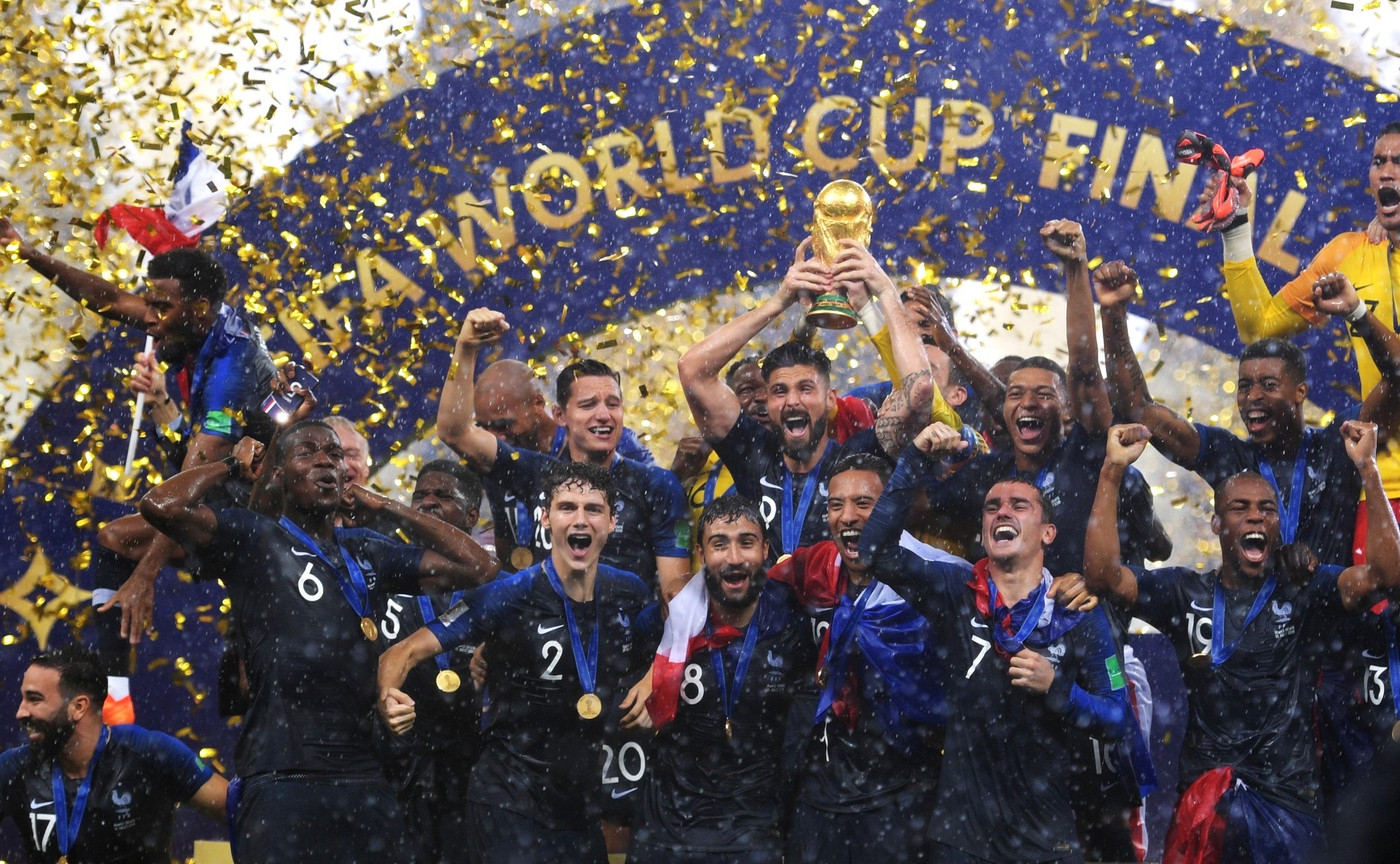
The French team celebrates their 2018 FIFA World Cup win in Russia after defeating Croatia 4–2 in the final. Image© Wikimedia
MIGRATIONS
MIGRATIONS
By Brenda Elsey and Laurent Dubois
For many, migration is foundational to what makes football meaningful. Professional teams around the world bring together players from very different backgrounds, many of whom are also migrants. The U.S.’s Major League Soccer, for instance, claims to have players from 79 different countries in its ranks.
National teams who play in the World Cup often include many players of immigrant backgrounds. The make up of many European teams, for instance, showcases the legacies of colonialism and post-colonial migration. The French team famously has long been led by players such as Zinedine Zidane, whose parents migrated from Algeria, and more recently Kylian Mbappé, who is of Algerian and Cameroonian background. In France and elsewhere in Europe, the presence of players of immigrant backgrounds has made football a stage for debates about migration and national identity. This complicates the idea that a World Cup is a neatly drawn series of contests between homogenous nations.
For more than a century, football has opened up international work opportunities to gifted players. However, these often confront racial, class, and gender barriers. As early as the 1920s, South American players leveraged their performances to land professional contracts in Europe, though the Afro-Uruguayan star José Andrade found the door shut to his migration because of racism. Today, however, most European professional teams include many players from the Global South. Thousands of players also move in different ways outside of Europe, from Nigeria to Turkey, from Argentina to China, and from Japan to Brazil.
While a small number of these reach the elite levels of the sport, most labor in less luxurious conditions, often with relatively low pay. Many youth academies and unscrupulous agents with insufficient oversight from federations also exploit young players with promises of residency and work permits and professional careers that never materialize.
Women athletes’ migration has been restricted by the historical underdevelopment of the sport, though this has begun to change. In 2004, the Brazilian legend Marta found a chance for a professional career in Sweden, while she waited for the rest of the world to catch up. Today, Marta plays in the U.S. National Women’s Soccer League, which increasingly showcases players from around the world, with a notable influx of African superstars in the past several years.
Football clubs have also played a role in maintaining community relationships in immigrant communities around the world. Club Palestino in Chile, for instance, provided a vibrant social space for members and helped change the image of Arab Chileans in the popular imagination. In the U.S., Latinx immigrants often animate and revitalize their communities through football. During international tournaments, notably in the U.S., it is fans from immigrant communities rooting for their nations of origin who often bring particular joy, pageantry, and style to the stadium.
For many, migration is foundational to what makes football meaningful. Professional teams around the world bring together players from very different backgrounds, many of whom are also migrants. The U.S.’s Major League Soccer, for instance, claims to have players from 79 different countries in its ranks.
National teams who play in the World Cup often include many players of immigrant backgrounds. The make up of many European teams, for instance, showcases the legacies of colonialism and post-colonial migration. The French team famously has long been led by players such as Zinedine Zidane, whose parents migrated from Algeria, and more recently Kylian Mbappé, who is of Algerian and Cameroonian background. In France and elsewhere in Europe, the presence of players of immigrant backgrounds has made football a stage for debates about migration and national identity. This complicates the idea that a World Cup is a neatly drawn series of contests between homogenous nations.
For more than a century, football has opened up international work opportunities to gifted players. However, these often confront racial, class, and gender barriers. As early as the 1920s, South American players leveraged their performances to land professional contracts in Europe, though the Afro-Uruguayan star José Andrade found the door shut to his migration because of racism. Today, however, most European professional teams include many players from the Global South. Thousands of players also move in different ways outside of Europe, from Nigeria to Turkey, from Argentina to China, and from Japan to Brazil.
While a small number of these reach the elite levels of the sport, most labor in less luxurious conditions, often with relatively low pay. Many youth academies and unscrupulous agents with insufficient oversight from federations also exploit young players with promises of residency and work permits and professional careers that never materialize.
Women athletes’ migration has been restricted by the historical underdevelopment of the sport, though this has begun to change. In 2004, the Brazilian legend Marta found a chance for a professional career in Sweden, while she waited for the rest of the world to catch up. Today, Marta plays in the U.S. National Women’s Soccer League, which increasingly showcases players from around the world, with a notable influx of African superstars in the past several years.
Football clubs have also played a role in maintaining community relationships in immigrant communities around the world. Club Palestino in Chile, for instance, provided a vibrant social space for members and helped change the image of Arab Chileans in the popular imagination. In the U.S., Latinx immigrants often animate and revitalize their communities through football. During international tournaments, notably in the U.S., it is fans from immigrant communities rooting for their nations of origin who often bring particular joy, pageantry, and style to the stadium.
For many, migration is foundational to what makes football meaningful. Professional teams around the world bring together players from very different backgrounds, many of whom are also migrants. The U.S.’s Major League Soccer, for instance, claims to have players from 79 different countries in its ranks.
National teams who play in the World Cup often include many players of immigrant backgrounds. The make up of many European teams, for instance, showcases the legacies of colonialism and post-colonial migration. The French team famously has long been led by players such as Zinedine Zidane, whose parents migrated from Algeria, and more recently Kylian Mbappé, who is of Algerian and Cameroonian background. In France and elsewhere in Europe, the presence of players of immigrant backgrounds has made football a stage for debates about migration and national identity. This complicates the idea that a World Cup is a neatly drawn series of contests between homogenous nations.
For more than a century, football has opened up international work opportunities to gifted players. However, these often confront racial, class, and gender barriers. As early as the 1920s, South American players leveraged their performances to land professional contracts in Europe, though the Afro-Uruguayan star José Andrade found the door shut to his migration because of racism. Today, however, most European professional teams include many players from the Global South. Thousands of players also move in different ways outside of Europe, from Nigeria to Turkey, from Argentina to China, and from Japan to Brazil.
While a small number of these reach the elite levels of the sport, most labor in less luxurious conditions, often with relatively low pay. Many youth academies and unscrupulous agents with insufficient oversight from federations also exploit young players with promises of residency and work permits and professional careers that never materialize.
Women athletes’ migration has been restricted by the historical underdevelopment of the sport, though this has begun to change. In 2004, the Brazilian legend Marta found a chance for a professional career in Sweden, while she waited for the rest of the world to catch up. Today, Marta plays in the U.S. National Women’s Soccer League, which increasingly showcases players from around the world, with a notable influx of African superstars in the past several years.
Football clubs have also played a role in maintaining community relationships in immigrant communities around the world. Club Palestino in Chile, for instance, provided a vibrant social space for members and helped change the image of Arab Chileans in the popular imagination. In the U.S., Latinx immigrants often animate and revitalize their communities through football. During international tournaments, notably in the U.S., it is fans from immigrant communities rooting for their nations of origin who often bring particular joy, pageantry, and style to the stadium.
Discussion questions:
Why has the history of football been so shaped by migration?
How have different communities of migrants brought distinctive cultural practices and politics to their newly adopted countries through football?
How are the labor conditions and migration patterns of football similar or different to other forms of labor migration?
What factors have propelled the women footballers to migrate to different parts of the world, and how has that shaped migration patterns for players?
READINGS
FREE TO ACCESS SOURCES
Laurent Dubois, Soccer Empire: The World Cup and the Future of France (University of California Press, 2010);
Laurent Dubois, Soccer Empire: The World Cup and the Future of France (University of California Press, 2010);
Ashwin Desai and Patrick Bond, “World Cup Woes for South Africa,” Against the Current (July/August 2010)
Ashwin Desai and Patrick Bond, “World Cup Woes for South Africa,” Against the Current (July/August 2010)
P. Darby, J. Esson, and C. Ungruhe, “Women’s Transnational Migration through Football: Possibilities, Responsibilities, and Respectability in Ghana,” International Review for the Sociology of Sport (2024): 1–19.
P. Darby, J. Esson, and C. Ungruhe, “Women’s Transnational Migration through Football: Possibilities, Responsibilities, and Respectability in Ghana,” International Review for the Sociology of Sport (2024): 1–19.
Matthew Taylor, “Global Players? Football, Migration and Globalization, c. 1930-2000,” Historical Social Research 31, 1 (2006): 7–30;
Matthew Taylor, “Global Players? Football, Migration and Globalization, c. 1930-2000,” Historical Social Research 31, 1 (2006): 7–30;
Van Campenhout, Gijs, Jacco Van Sterkenburg, and Gijsbert Oonk. 2019. “Has the World Cup Become More Migratory? A Comparative History of Foreign-Born Players in National Football Teams, c. 1930-2018.” Comparative Migration Studies 7 (1): 22.
Van Campenhout, Gijs, Jacco Van Sterkenburg, and Gijsbert Oonk. 2019. “Has the World Cup Become More Migratory? A Comparative History of Foreign-Born Players in National Football Teams, c. 1930-2018.” Comparative Migration Studies 7 (1): 22.
Michael de Vulpillieres, ‘Football is Love’, The New Context, February 2021.
Michael de Vulpillieres, ‘Football is Love’, The New Context, February 2021.
Cara Snyder, “Exposing fascism: The rise of bolsonarismo and the naked politics of Brazil’s first trans men’s football team,” Latin American Research Review, 2023
Cara Snyder, “Exposing fascism: The rise of bolsonarismo and the naked politics of Brazil’s first trans men’s football team,” Latin American Research Review, 2023
Moreira, V., & Garton, G. (2021); Football, nation, and women in Argentina: Redefining the field of power. Movimento, 27, e27003.
Moreira, V., & Garton, G. (2021); Football, nation, and women in Argentina: Redefining the field of power. Movimento, 27, e27003.
Christopher Gaffney, “The lost legacy of Brazil’s World Cup,” Playthegame.org, June 6, 2014
Christopher Gaffney, “The lost legacy of Brazil’s World Cup,” Playthegame.org, June 6, 2014
“EQUAL PAY!!!” Burn It All Down, Ep. 252 (2022)
“EQUAL PAY!!!” Burn It All Down, Ep. 252 (2022)
ADDITIONAL SOURCES
Paul Darby, J. Esson, and C. Ungruhe, African Football Migration: Aspirations, Experiences and Trajectories (Manchester University Press, 2022);
Paul Darby, J. Esson, and C. Ungruhe, African Football Migration: Aspirations, Experiences and Trajectories (Manchester University Press, 2022);
Brenda Elsey, Citizens and Sportsmen: Fútbol and Politics in Twentieth-Century Chile (University of Texas Press, 2011).
Brenda Elsey, Citizens and Sportsmen: Fútbol and Politics in Twentieth-Century Chile (University of Texas Press, 2011).
Agergaard, Sine, and Nina Clara Tiesler. 2014. Women, Soccer and Transnational Migration. Routledge.
Agergaard, Sine, and Nina Clara Tiesler. 2014. Women, Soccer and Transnational Migration. Routledge.
Jermaine Scott, “‘Harlem’s Chief Representatives’: The Radical Politics of Black Soccer in New York, 1928–1949,” Journal of African American History 106, n. 2 (2021): 196–219.
Jermaine Scott, “‘Harlem’s Chief Representatives’: The Radical Politics of Black Soccer in New York, 1928–1949,” Journal of African American History 106, n. 2 (2021): 196–219.
Roger Kittleson, The Country of Football: Soccer and the Making of Modern Brazil (University of California Press, 2014).
Roger Kittleson, The Country of Football: Soccer and the Making of Modern Brazil (University of California Press, 2014).
David Winner, Brilliant Orange: The Neurotic Genius of Dutch Football (Bloomsbury, 2001)
David Winner, Brilliant Orange: The Neurotic Genius of Dutch Football (Bloomsbury, 2001)
Christopher Gaffney, “The Urban Impacts of the 2014 World Cup in Brazil,” in Richard Gruneau and John Horne, eds., Mega-Events and Globalization: Capital and Spectacle in a Changing World Order (Routledge, 2016): 167–185;
Christopher Gaffney, “The Urban Impacts of the 2014 World Cup in Brazil,” in Richard Gruneau and John Horne, eds., Mega-Events and Globalization: Capital and Spectacle in a Changing World Order (Routledge, 2016): 167–185;
READ NEXT

World Cup: The Syllabus is a project of the Global Sport Lab and the Jackson School of International Studies at the University of Washington.

CONTACT US
The Henry M. Jackson School of International Studies
2023 Skagit Lane, Thomson Hall, Box 353650 Seattle, WA 98195-3650
T: (206) 543-4370


Text on this page created by the Global Sport Lab at the
University of Washington is licensed under a CC BY-NC 4.0 license.
Images and video are not included.
CONTACT US
The Henry M. Jackson School of International Studies
2023 Skagit Lane, Thomson Hall, Box 353650 Seattle, WA 98195-3650
T: (206) 543-4370
Text on this page created by the Global Sport Lab at the
University of Washington is licensed under a CC BY-NC 4.0 license.
Images and video are not included.

CONTACT US
Text on this page created by the Global Sport Lab at the
University of Washington is licensed under a CC BY-NC 4.0 license.
Images and video are not included.
CONTACT US
Text on this page created by the Global Sport Lab at the
University of Washington is licensed under a CC BY-NC 4.0 license.
Images and video are not included.